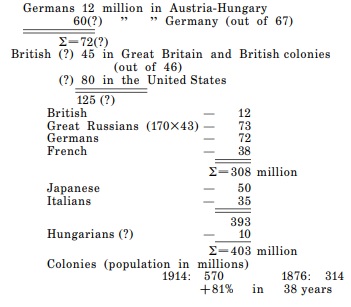
Great-Power Nations
(Hofkalender, 1914)
1910
Subject: Imperialism and the self-determination of nations
| not the “national question | ||||
Away with two-thirds of the national programme (only self-determination)
+ Democratic reforms under imperialism?
+ Norway 1905. An “exception”?
+ Ireland 1869. “Utopia”?
+ National movements in Asia and the colonies... and Africa (Egypt)....
+ Why division into nations when imperialism is the epoch of the union of nations?
“Why” national movements in the Ukraine, China, Persia, India, Egypt, etc., “if” (when) the advanced countries have reached the stage of imperialism, which unites nations?, if capitalism (= imperialism) in the advanced countries has outgrown the bounds of national states? The Proudhonists and Marx in the 1860s. (“Other nations should sit on their behinds and wait until France achieves the social revolution.”)
Marx 1848 in Die Neue Rheinische Zeitung. Engels 1866 and Marx 1869: precisely in the interests of the working class of the oppressing nations it is necessary to demand freedom of secession for the oppressed nations.
| Page 1: 2-3[1] (compress and alter) |
Imperialism is oppression of nations on a new historical basis.... This is one half. The other half (of the problem) = emergence of national movements in Eastern Europe (the Ukraine after 1905), in Asia and Africa (China, India, Egypt)—in the colonies (among 1,000 million of the population of the globe 570 + 360 = 930).... |
| 300-400 million out of 1,600 are oppressors | ||||
|
Self-determination of nations [“old, tattered” (schäbig) bourgeois-demo- cratic slogan ((new for 1,000 million of the world’s population!!))] must be converted from a deception to a truth. |
pp. 4-5 delete. p. 6 (to be revised) |
|
Deception for Britain, France and for Germany Two forms of deception: Plekhanov |
|||||||||
|
contra “the most tattered” slogan of Parvus. |
|||||||||
Only a bourgeois-democratic principle? What about the BROTHERHOOD of the workers?
No, it is also a socialist principle.
When we advance the slogan: freedom of self-determination, that is, freedom of secession, by our whole agitation we are demanding from the oppressors: try to hold the people by granting advantages, spreading culture, and not by force. If we do not accept and emphasise freedom of secession, we in practice leave the door open for the advocates of violence.
Nur so treffen wir den Nagel auf den Kopf [only so do we hit the nail on the head]—we teach the workers: drive away all those who do not recognise the democratic and socialist principle sincerely and honestly.
Five (?) (better four) theses: (1) Social-Democrats of an oppressor nation, particularly of the so-called Great Powers, must demand the right to self-determination = the right to secession for the oppressed nations, upholding this right not only in the legal, but especially in the illegal, press and especially in wartime.—(2) Social-Democrats of the oppressed nations must demand the fullest, including organisational, merging, and not merely rapprochement, of the workers of the oppressed nation with the workers of the oppressor nation.—(3) On the basis of these principles, the Social-Democrats of all the advanced twentieth-century countries, and especially of the Great Powers, must make the principle: “the workers have no fatherland” the cornerstone of their national policy, without in any way denying the world-historic importance of the national emancipation movement of the backward East European and the Asian and African colonial peoples.—(4) Social-Democrats of all countries must uphold, not the federative principle, not the formation of small states, as the ideal, but the closest unity of nations, stressing the harmfulness of all separation of nations, the harmfulness of cultural-national autonomy, the advantage of democratic centralism, the advantage of very big states and unions of states.
5th thesis: In view of the elementary, ABC nature of thesis No. 1, its acceptance by all democrats and Marx + Engels 1848-76, and its confirmation by the experience of the war,—Social-Democrats who do not recognise this thesis should be treated as enemies of the proletariat and deceivers of the worst kind, and expelled from the Party.
It is not enough to accept the struggle against all national oppression, against all national inequality:
(α) Does “inequality” cover the right to independent statehood? or not?
(β) the right to secession or not?
(γ) the nature of daily agitation: its main aim and direction.
Unity of the workers, unity of the proletariat’s international class struggle, is infinitely more important than the problem of state frontiers, which in the era of imperialism will especially often be resolved, by war.
[October 28, 1915]
Introduction
(1) The urgency of the Problem: A talking point everywhere. Why? (α) War inflames national enmity and threatens
national oppression.
(β) Imperialism is the era of the oppression of nations on a new historical basis.
(2) The task of the “Zimmerwald Left”[] is to unite, and on this basis also to smash social-chauvinism, to clarify the mind of the working class.
I. The Economic Standpoint
(3) “Capital has outgrown national bounds. The union of nations (in a single state) is inevitable and progressive.” True! But Marxism is not Struvism,[6] it is not a justification and defence of coercion of nations, but a revolutionary struggle for socialism, the union of the workers of different nations, their brotherhood.
(4) Against coercion, for the democratic union of nations. “Freedom of secession” is the highest expression of democracy.
(5) Democracy, freedom of secession, benefit economic union (Norway and Sweden; America versus Germany).
II. The Historical Standpoint
(6) “Self-determination is the tattered slogan of a bygone era of bourgeois-democratic revolutions and movements.”
—Imperialism gives rise to the oppression of nations on a new basis. Imperialism gives new life to this old slogan.
(7) The East and the colones (> 1,000 million of the world’s population). “New” bourgeois-democratic national movements.
| Colonies | 1876—314 | million | + 81% |
| 1914—570 | ” |
III. The Political Standpoint
(8) We do not discard bourgeois-democratic slogans, but more consistently, fully and decisively implement what is democratic in them.
(9) The interests of brotherhood, of the solidarity of the workers of different nations, rather than the interests of nations.
IV. The Standpoint of State Frontiers
(10) We do not uphold the existing state frontiers.
(11) We do not support the utopia of small states, do not everywhere and always demand the “independence of national states”....
(12) Under all possible changes of state frontiers we put in the forefront the interests of the workers’ class struggle.
(13) The “disintegration” of Russia (Great Britain, Austria?) = United States.
V. The Standpoint of the Proletariat’s
International Class Struggle
(14) The danger (and inevitability under capitalism) of national enmity and distrust (à la Axelrod? No!).
(15) The crux: the attitude of the oppressing nations to the oppressed nations.
(16) The class solidarity of the workers of different nations is impossible without recognising the right to secession.
VI. “Practical Feasibility”
(17) “Utopia”! Norway versus Sweden.
(18) The “exception”! (“Backwoods region.”) Yes, like all democratic reforms and changes.
(19) “In practice = nil.”
No = (α) freedom of agitation for secession
(β) solution of the problem of secession by a referendum (2 §§ of the Constitution)
(20) “What guarantees are there? Only war can give the answer!”
(Our guarantees—educating the workers in the spirit of the brotherhood of nations.)
VII. The Military Standpoint
(21) “Self-determination of nations = justifying participation in war.”
There are wars and wars. We do not “deny” national wars. They are possible now, too.
(22) “Given self-determination, Holland, Sweden, etc., have the right to defend themselves.” How can one defend oneself in an imperialist war?
VIII. The Struggle
Against Social-Chauvinism
(23) Social-chauvinism is as inevitable a product of imperialism as wireless telegraphy. The struggle against it is now the very heart of the matter.
(24) The struggle against the chauvinism of one’s own nation.
(25) The main feature—Great-Power chauvinism.
(26) “Recognition of equality” = an evasion of the problem of statehood, of secession, of instances of imperialist war
(27) Wir treffen den Nagel auf den Kopf (we hit the nail on the head) only by our formulation. Only this formulation strikes at and smashes international social-chauvinism.
IX. Comparison with Divorce [2]
(28) Rosa Luxemburg on divorce (versus autonomy).
(29) Semkovsky’s objection.
(30) Its incorrectness.
X. The Case Weill [7]
(31) The social-chauvinists expelled Weill, who betrayed their principles.
(32) From our point of view, participation in war is not a crime. How else can agitation be conducted in the army? or the war turned into a civil war?
(33) Choice of nation. (In what army?)
XI. Attitude of the Liberal Bourgeoisie
(34) In Russia: we (Constitutional-Democrats) are for equality, but we have never undertaken to defend the right to secession from the Russian state.
(35) Karl Kautsky on political self-determination (“cultural self-determination and autonomy is enough”)....
XII. Experience of the R.S.D.L.P.
(36) How the question was posed at the 1903 Congress.
(37) Withdrawal of the Polish Social-Democrats and their re-entry in 1906.
(38) Abolition of §9 was never officially demanded.
(39) “Alliance” of the opportunists with Rosa in 1914 (the liquidators Semkovsky; Liebman; Yurkevich; Alexinsky).
XIII. The Example of Marx and Engels
(40) 1848. Germany versus the oppressed nations (Literarische Nachlass, III, pp. 109, 113 and 114).
1866. Engels and the International (Marx) on Poland and Germany.
1869. Marx on Ireland.
(41) From the standpoint of the interests of the workers of the oppressing nation.
| (N.B.) Marx for federation with Ireland (N.B.) | ||||
XIV. The Zimmerwald Left “Formula”
(42) “No support for the rule of one nation over another”....
|
Question: does it include freedom of secession? Non-recognition of freedom of secession is “support for the rule”. |
||||
This formulation=“the first step towards closer unity”....[3]
[1] Apparently, a reference to the pages of some manuscript of Lenin’s.—Ed.
[2] See present edition, Vol. 23, pp. 72-74.—Ed.
[3] See present edition, Vol. 21, pp. 383-88.—Ed.
[4] In the later part of October 1915, Lenin proposed to deliver lectures in Zurich and Geneva: “On the 22nd in Zurich, on the 20th in Geneva”—he wrote to V. A. Karpinsky in Geneva (see Lenin Miscellany XI, p. 184). The lecture in Zurich, “The International Socialist Conference of September 5-8, 1915”, was delivered on October 23. Concerning the date of the Geneva lecture, Lenin wrote: “If possible, fix it for two days before or after” (ibid., p. 185). The subject of the Geneva lecture was, evidently, decided upon somewhat later: “I shall write about the lecture tomorrow” (letter to Karpinsky, October 6; ibid., p. 189). The conspectus, “Imperialism and the Right of Nations to Self-Determination”, apparently relates to the Geneva lecture delivered by Lenin on October 28, 1915.
[5] Lenin described the Zimmerwald Conference of internationalist socialists (September 1915), as a “first step” in the development of the international movement against the imperialist war. Socialists from eleven European countries, including Russia, Germany, France and Italy, took part.
The Conference Manifesto was directed against the imperialist governments that had unleashed the world war, and condemned, although not strongly enough, the social-chauvinists. On the basis of the Manifesto, the Zimmerwald group was formed.
The Zimmerwald Left, led by Lenin, took shape at the Conference. It sharply criticised the Kautskyite majority of the Conference and proposed that the resolutions call for a complete break with social-chauvinism and for revolutionary struggle of the masses against their imperialist governments.
The Zimmerwald Left elected a Bureau which after the Conference continued to work for unity of the revolutionary internationalist forces.
[6] Struvism, “legal Marxism”—a bourgeois-reformist distortion of Marxism. P. B. Struve and other “legal Marxists” tried to use Marxism and the working-class movement in the interests of the bourgeoisie. Lenin described Struvism in the following words: “Struvism is not merely a Russian, but ... an international striving on the part of the bourgeois theoreticians to kill Marxism with ‘kindness’, to crush it in their embraces, kill it with a feigned acceptance of ‘all’ the ‘truly-scientific’ aspects and elements of Marxism except its ‘agitational’, ‘demagogic’, ‘Blanquistutopian’ aspect. In other words, they take from Marxism all that is acceptable to the liberal bourgeoisie, including the struggle for reforms, the class struggle (without the proletarian dictatorship) the ‘general’ recognition of ‘socialist ideals’ and the substitution of a ‘new order’ for capitalism; they cast aside ‘only’ the living soul of Marxism, ‘only its revolutionary content” (see present edition, Vol. 21 p. 222). During the First World War, Struve was one of the ideologists of Russian imperialism; under cover of Marxist phrases he tried to justify the predatory war, annexations and the enslavement of small nations by the Great Powers
[7] G. Weill—a German revisionist Social-Democrat, a native of Alsace-Lorraine. During the imperialist war he went over to the French, volunteered in the French army and was expelled from the Party. His credentials as a deputy were cancelled and he was declared a deserter.
| | |
| | | | | | | ||||||